Energy consumption
The figures on this page summarize measurements of local language-model inference. They are estimates for the specific models and setup tested.
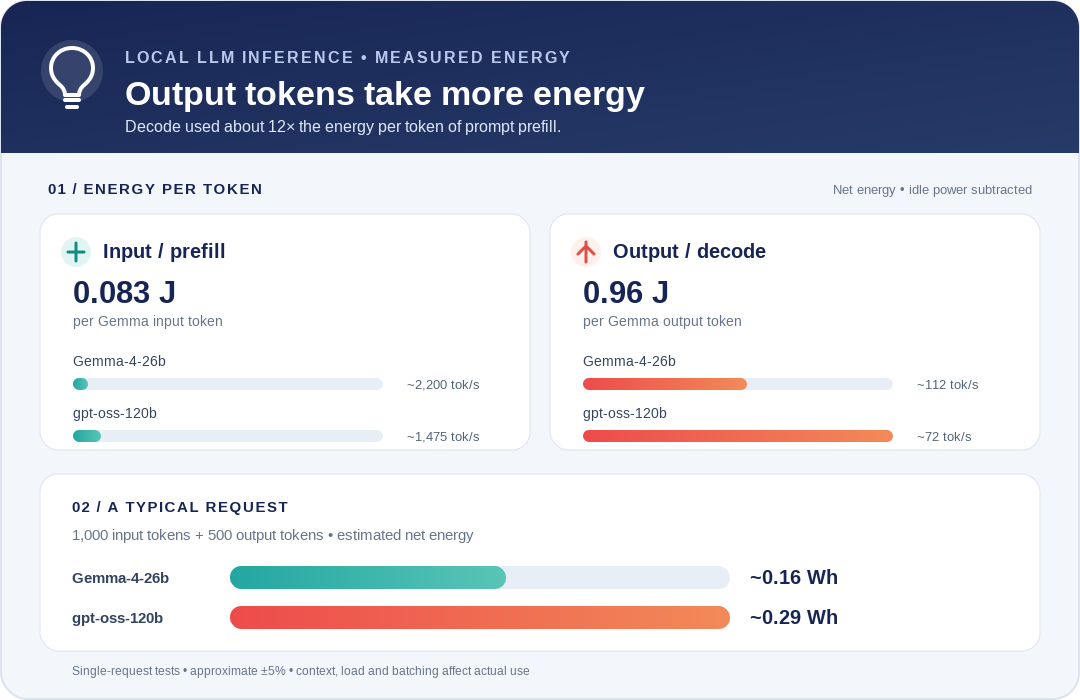
Results
| Model | Phase | Throughput | Net energy per token | Gross energy per token |
|---|---|---|---|---|
| Gemma-4-26b | Input (prefill) | ~2,200 tokens/s | ~0.083 J | ~0.087 J |
| Gemma-4-26b | Output (decode) | ~112 tokens/s | ~0.96 J | ~1.04 J |
| gpt-oss-120b | Input (prefill) | ~1,475 tokens/s | ~0.153 J | ~0.161 J |
| gpt-oss-120b | Output (decode) | ~72 tokens/s | ~1.82 J | ~1.97 J |
Net energy is the measured energy after subtracting idle power. Gross energy includes the idle-power share during the measured phase. The system's idle draw was about 9 W for the Gemma run and 11 W for the gpt-oss run.
An output token used about 12 times as much energy as an input token for both models. Decode generates tokens sequentially, while prefill processes the prompt in parallel.
Example request
For a request with 1,000 input tokens and 500 output tokens, the measured net energy is approximately:
| Model | Calculation | Approximate energy |
|---|---|---|
| Gemma-4-26b | (1,000 × 0.083 J) + (500 × 0.96 J) | 563 J (~0.16 Wh) |
| gpt-oss-120b | (1,000 × 0.153 J) + (500 × 1.82 J) | 1,063 J (~0.29 Wh) |
In these measurements, Gemma used about 53% of the energy per token of gpt-oss-120b in both prefill and decode. This comparison says nothing about answer quality; quality and suitability should be assessed separately.
Comparison with public cloud figures
Cloud providers rarely publish energy per token or per request for specific models. One useful reference is the independent study How Hungry is AI? Benchmarking Energy, Water, and Carbon Footprint of LLM Inference. It estimates energy for hosted models using public API performance, published hardware power specifications, and data-center overhead factors. These are research estimates, not measurements or figures published by the providers.
The study reports estimates for a request with 1,000 input and 1,000 output tokens. Applying our measured per-token rates to the same token counts gives the following rough comparison:
| Model or service | Energy for 1,000 input + 1,000 output tokens | Figure type |
|---|---|---|
| Gemma-4-26b (local) | ~0.29 Wh | Calculated from our measured net energy per token |
| gpt-oss-120b (local) | ~0.55 Wh | Calculated from our measured net energy per token |
| GPT-4.1 nano | 0.575 ± 0.108 Wh | Independent study estimate |
| GPT-4o (March 2025) | 1.215 ± 0.241 Wh | Independent study estimate |
| DeepSeek-V3 on Azure | 2.165 ± 0.578 Wh | Independent study estimate |
These figures are not a controlled comparison. Our local values are extrapolated from per-token measurements, with decode measured at short context; the study's hosted-model values use inferred hardware and data-center assumptions. Model versions, deployment, batching, regions, and measurement boundaries also differ. Treat them as context, not as evidence that one service is inherently more energy-efficient.
For comparison, the study also cites an OpenAI statement that a typical ChatGPT query used about 0.34 Wh in June 2025. The statement did not specify token counts, so it cannot be normalized to the request above and should not be read as a current, model-specific figure.
Measurement setup
- Models and serving: Gemma-4-26b and gpt-oss-120b, served with oMLX through its OpenAI-compatible API.
- Power: Whole-machine power was read from the system management controller using macmon's
sys_powermeasurement, sampled every 250 ms. It includes CPU, GPU, memory, SSD, and fans, but excludes power-supply losses. - Method: Requests ran one at a time. Prefill (reading the prompt) and decode (generating output) were measured separately, using only power samples that fell within each phase. A random prefix was added to each prompt to prevent cache reuse. Idle power was measured between trials and subtracted to calculate net energy.
- Gemma trials: Two runs of six trials each. The reported figures are from the second run, after reaching thermal steady state. Trials identified as slowed by outside requests were excluded based on speed; the first run's clean trials agreed within 2%.
- gpt-oss trials: Six trials. The first two were warm-up trials; results use trials 3–6 after the machine reached thermal steady state. Trial-to-trial variation was under ±1%; a cold-start run was about 4% lower.
Limitations
- Measurements were made with one request at a time. Concurrent requests may be batched and could reduce energy per token.
- Decode used a short context, while prefill used a prompt of about 6,000 words. Longer contexts can change both figures.
- Wall-socket consumption is likely 5–10% higher because the measurements exclude power-supply losses.
These are measurements of particular models under a particular workload and thermal state. Actual energy use will vary with hardware, context length, output length, concurrency, and system load.